Decision Models vs. LLMs: Does This Task Really Need a Chatbot?
October 21, 2026
Your software needs a yes or no. The model submits an essay. Before adding another chatbot to a business workflow, ask what the next step actually consumes. For hands-on experiments, start with a Jupyter GPU workspace on weightroom. It's an experiment environment, not a preinstalled Clef deployment; check the model's runtime and hardware requirements separately.
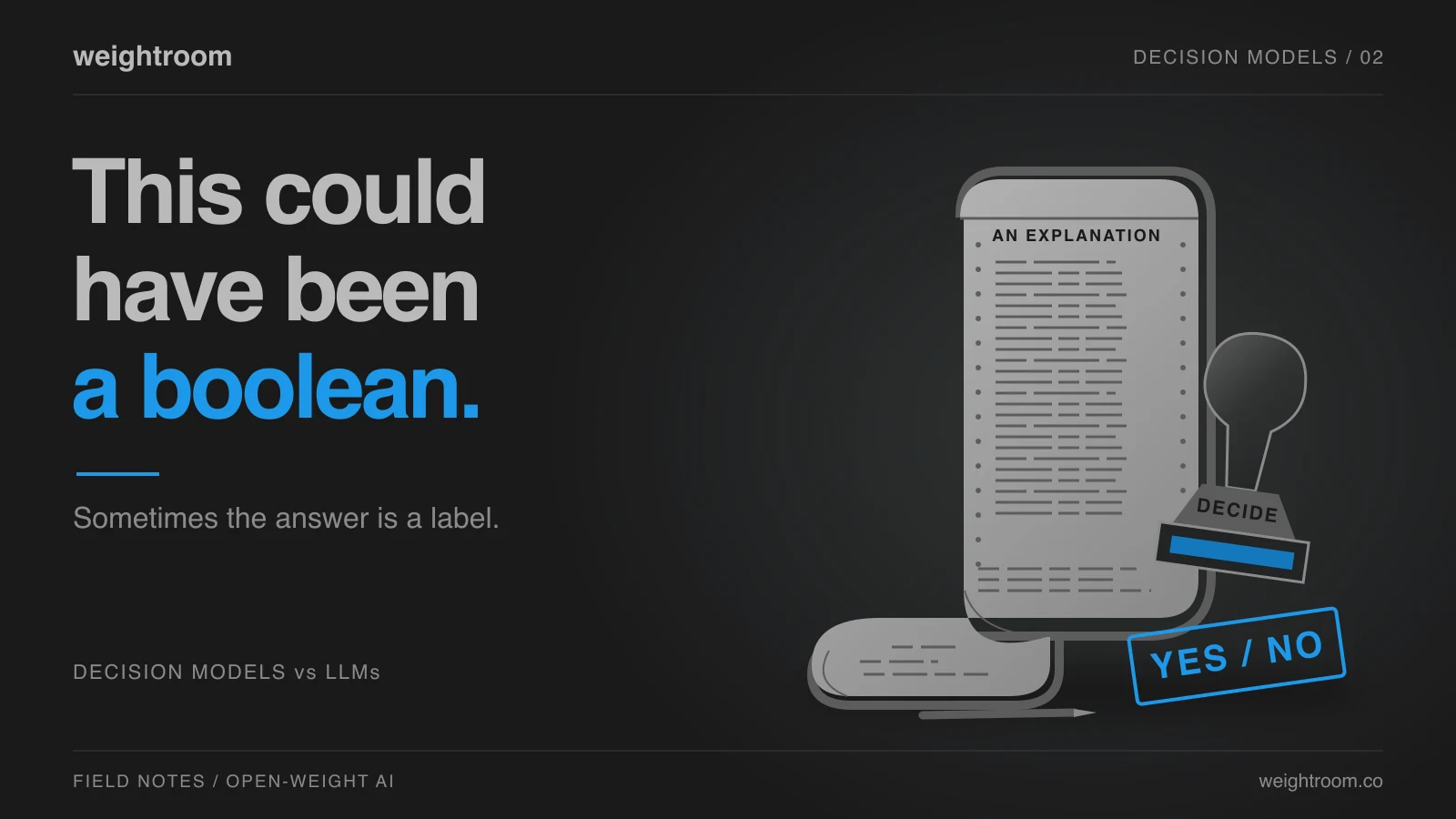
This could have been a boolean.
Choosing an answer versus writing one
A decision model selects from defined outcomes: a team, a boolean, or an ordered severity level. A generative LLM writes text: a reply, summary, explanation, or plan. Start with the output your application needs, not the model category attracting the most attention.
This isn't “JSON versus chaos.” General LLMs can use structured outputs and constrained decoding too. A valid schema doesn't guarantee a correct decision, whichever approach produces it.
| Your next step needs… | Start by evaluating… | Watch for… |
|---|---|---|
| A label from known options | A decision model | Wrong labels, missing categories |
| A reply or explanation | A generative LLM | Unsupported claims, tone, completeness |
| Routing followed by a reply | A classifier plus a generator | Errors passed between stages |
| An exact rule on known fields | Ordinary code | Unnecessary model complexity |
What Clef changes
In Cloudflare's Clef announcement, the important distinction is architectural: Clef uses a Qwen backbone with a decision-scoring mechanism. It reads the input in a prefill-only pass and scores allowed schema choices rather than generating the answer token by token. It supports text and images and returns typed decisions with probabilities.
Ollama's Clef introduction describes local and cloud availability. Neither announcement establishes performance on your customers' messages or compatibility with your chosen workspace. Treat upstream benchmarks as reasons to investigate, not deployment guarantees.
A small-business example
Imagine a support inbox receiving “Checkout is broken, and I'd also like to upgrade.” A decision model could classify the destination and urgency; your application could flag conflicting signals for human review. A generative LLM could then draft a response using approved context.
These are different jobs. Routing doesn't need a paragraph. A helpful customer reply usually needs more than true. Neither model should independently authorize a refund just because it recognized a refund request.
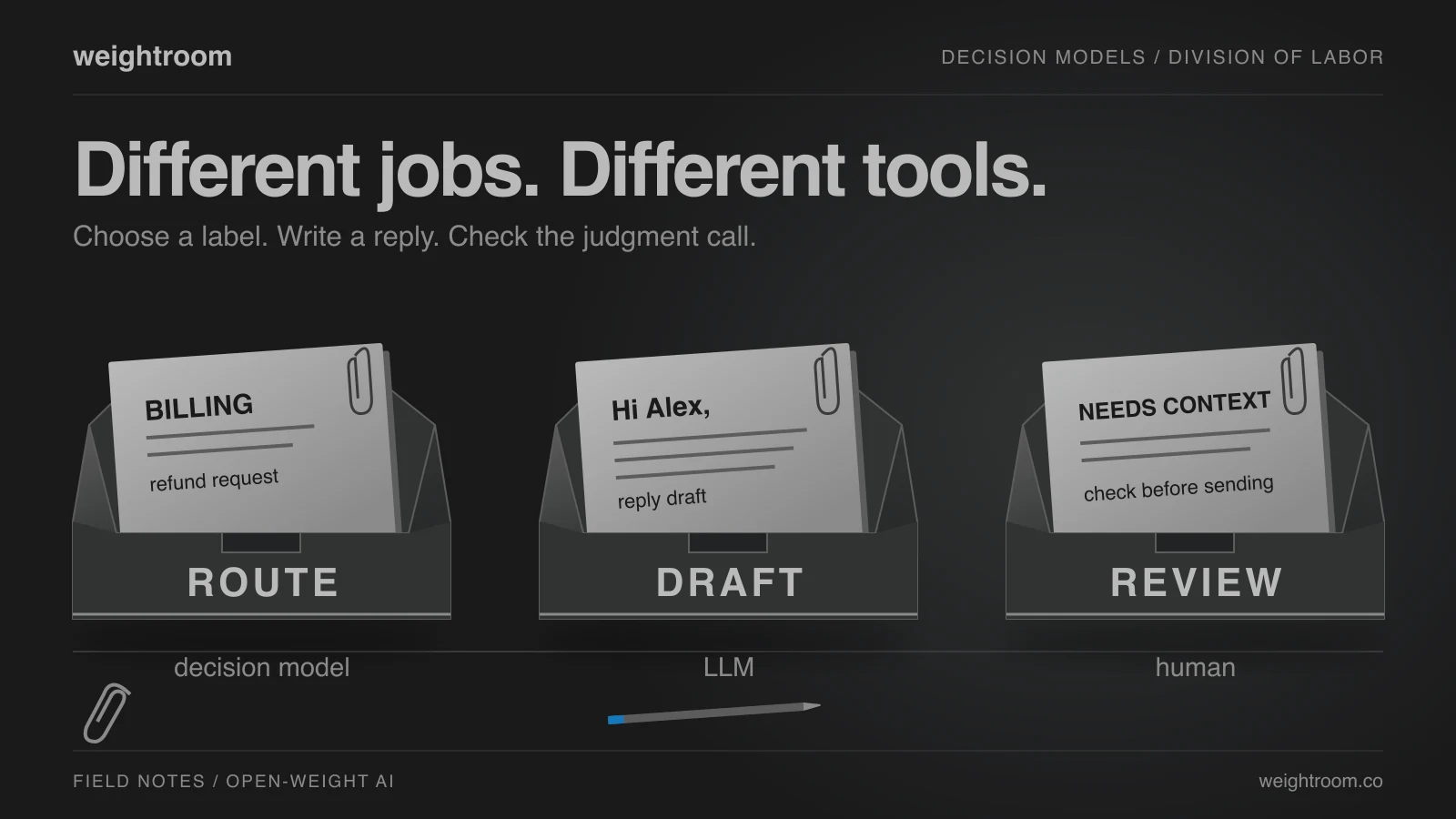
An illustrative workflow, not measured model output. Your application defines the review rules.
Evaluate before automating
- Hold out real labels. Reserve representative, human-reviewed examples that aren't used for training, prompt tuning, or threshold selection.
- Inspect costly errors. Compare missed urgent cases and unnecessary escalations, including rare categories and ambiguous inputs—not just overall accuracy.
- Measure the full system. Include network calls, preprocessing, queueing, downstream actions, and review effort when comparing latency and cost.
- Make uncertainty actionable. Check probability calibration on held-out data. Test a human-review threshold and a route for unfamiliar cases; confidence isn't proof.
Need a domain-specific training path? Our Unsloth decision-model walkthrough trains a Qwen3.5-4B decision head and adapters. It is a separate approach, not a recipe for reproducing Clef's architecture.
Open a Jupyter GPU workspace, review the available hardware and price, and compare one bounded task before rebuilding the whole workflow.
Explore GPU Workspaces.
Choose a pre-configured environment for development, training, or inference.